
Cataract Surgery In Singapore
Bladed Phaco-emulsification Cataract Surgery
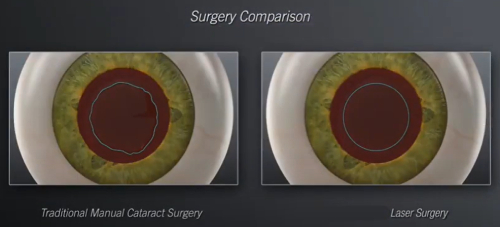
is where all the incisions and openings are manually made with knives and sharp instruments inside the eye, followed by ultrasonic energy to aspirate and remove the cataract. This technology is now more than 50 years old and although the incision size is now a lot smaller than it used to be 50 years ago, certain aspects of Manual Phaco-emulsification are performed with limited precision and still has room for human errors to occur resulting in loss of vision.
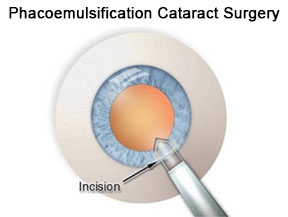
A knife enters the eye to make a
corneal incision
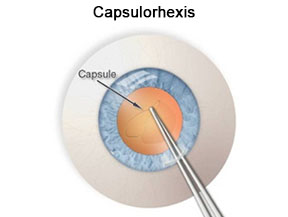
A sharp micro-forcep enters the eye to tear
the capsule surrounding the cataract
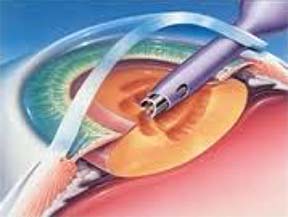
The cataract is sculpted manually using
higher ultrasound energy level
Bladeless Laser Cataract Surgery
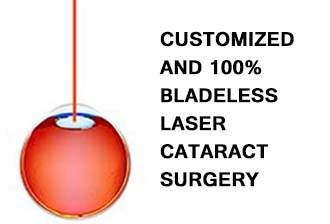
Femtosecond Laser Cataract Surgery Machine for Customizing 100% Bladeless Cataract Surgery
Intelligent Bladeless Femtosecond Laser wound construction
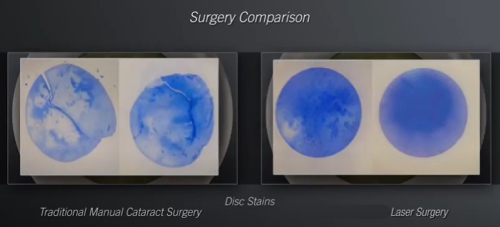
Perfectly round and centric capsule opening performed bladeless
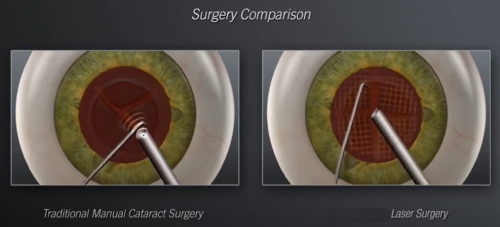
Bladeless division of cataract into smaller pieces requires less ultrasound energy for total removal of cataract, enabling a faster post-op visual recovery.
A perfectly well-centred premium lens implant which corrects myopia, astigmatism andpresbyopia (“Lao Hua”) can achieve total spectacle freedom to meet the demands of the modern cataract patient
What are the advantages? Is it just hype? As a lay person, are there really practical advantages to having a computer-guided and 100% Bladeless Femtosecond Laser Cataract Surgery?
100% Bladeless Femtosecond laser cataract surgery offers a paradigm shift in cataract surgery. Clinical evidence in support of the use of the technique is rapidly accumulating, and increased safety is a plus point.
Artificial Intelligence (AI) in modern cataract surgery out-performs a surgeon’s hand, reduce chance of human errors, provide greater precision and reproducibility.
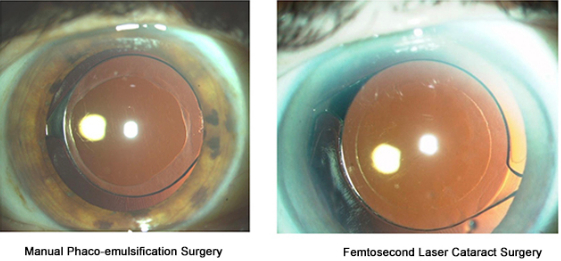
One month follow-up after Cataract Surgery
NOVENA Bladeless Cataract Surgery and Eye Specialist Centre is the first and clinic with our own in-house MOH-licensed Eye Ambulatory Surgery Centre that offers Precise Computerised Cataract Suite and 100% Bladeless Cataract Surgery from the minute a diagnosis is made to the finish of the cataract surgery journey:
The Computerized Refractive Cataract Suite provides computer guidance to intra-ocular lens implantation. It performs pre-operative measurements of intra-ocular lens implants using Optical Coherence Tomography imaging of the entire length of the eye for an even greater accuracy. It captures unique feature points and curvature gradients of the eyeball for use as reference points so that no more manual eye marking is necessary for precision lens implant alignment. This data is automatically transferred to the eyepiece of the computer-assisted operating microscope for real-time active eye axis tracking throughout the surgery.
This is paired with our centre’s Femtosecond Laser, an FDA-approved system, bringing both laser precision technology and computer-guided consistency to cataract surgery. Treatment is fully customized to each individual’s eye, enabling better intra-ocular lens implant placements and the most accurate visual outcomes. These advantages are especially important when it comes to centration and alignment of the high-definition (HD), premium intra-ocular lens implants such as presbyopia-correcting multi-focal and the high definition (HD) mono-vision lens implants. It is also the most precise form of correction for cylinder axis in eyes that suffer from astigmatism.
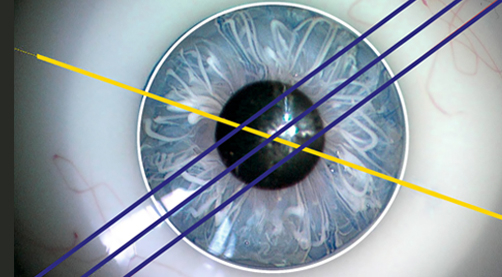
The reference appears as an overlay by a software. The software continuously tracks the patient’s eye throughout surgery in high resolution to provide assistance overlays. This has been proven. It is a more precise method of alignment of intra-ocular lens implant.
With patients appreciating the ability to customize their vision, incremental clinical advantages such as experiencing greater precision procedures and faster recovery periods, and once again enjoying the vision they had in their 20s without glasses, it is no surprise that this innovative procedure is rapidly setting the new standards for modern cataract surgery.
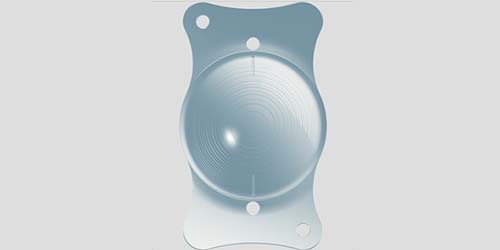
For an all-in-one correction of myopia, astigmatism and presbyopia, Computer-Guided Multi-focal lens implantation ensures pristine lens centration and even better visual outcomes.
Is there going to be a huge premium for this type of surgery? Will it be coverable by Insurance and Medisave?
The main concern from patients presently is whether this technology is affordable or not. Yes it is coverable by Insurance and Medisave. Doctor’s fees and hospital facility fees vary greatly from person – to – person, place – to –place. You will find some doctors performing traditional manual phaco-emulsification who are charging more than some doctors performing 100% Bladeless Femtosecond Laser Cataract Surgery, and vice versa. For any surgical procedures, there are no fixed fees.
The issue of cost arises with any new technology and is always resolved. Whenever a superior technology emerges, it ultimately succeeds. NOVENA Bladeless Cataract Surgery & Eye Specialist Centre owns its Ambulatory Surgery Centre Operating Facility, its own computerized cataract suite for lens alignment and lens implantation, its own Femtosecond Laser for 100% Bladeless Cataract Surgery and aims to make this technology affordable to the mass market. The private sector has had a reputation of being “expensive”. The Centre’s mission is to deliver cutting edge technology with the assured expertise and strike off exorbitant facility / machine fees as it controls its own pricing, instead of being dependent on third party hospital’s facility fees. For NOVENA Bladeless Cataract Surgery & Eye Specialist Centre, there will not be huge difference in price between the traditional manual Phaco-emulsification and 100% Bladeless Femtosecond Laser Cataract Surgery.
We understand what the patients are looking for and their prime concerns. We only want to deliver the best and we want to make it affordable. Whilst cataract surgery is often associated with half a day of hospital stay with elaborate admission and discharge protocols, NOVENA Bladeless Cataract Surgery Centre boasts a privately run Ambulatory Surgery Centre IN – HOUSE that saves on time and mental anxiety of patients by completing their cataract surgeries within 15 minutes in an environment of relaxation and comfort, without the need for intravenous sedation or eye injection , enabling initial admission to final discharge time of 1 hour , and patients can make their own way home safely.
If you yourself needed cataract surgery today? Would you go for this new technology or would you go for something that has been around in the market for the last few decades with proven results?
If I needed cataract surgery today, which method – manual or Bladeless Femtosecond Laser Cataract Surgery would I choose for my eyes? For me there is only one choice. I would select the Bladeless Femtosecond Laser. This is not debatable, it is a fact. Why not enjoy better safety and greater precision if I could. Bladeless Femtosecond Laser Cataract Surgery is the future of cataract surgery and the future is here.
Bladeless Laser Cataract Surgery II
- What are the Safety and Accuracy advantages of 100% Bladeless Cataract surgery and Computer-guided Lens implantation?
- What is your step-by-step approach to advanced 100% Bladeless Laser Cataract Surgery in patients with Presbyopia and Astigmatism?
Cataract surgery Techniques, Accuracy and Safety have improved incrementally over the last 50 years and is now considered one of the safest and most successful surgeries performed worldwide.
With modern technological advances, we can use Artificial Intelligence (AI) to minimize human errors and improve on the results and accuracy of the surgery with the use of Bladeless Laser Cataract Surgery & Computer-guided Lens Implantation technique. Using the latest generation of Mono-focal, Multi-focal and Astigmatism-correcting Lenses, the triple demands of Precision, Safety and Comfort in surgery at every single step of your Cataract journey has become a reality, 100% blade-free.

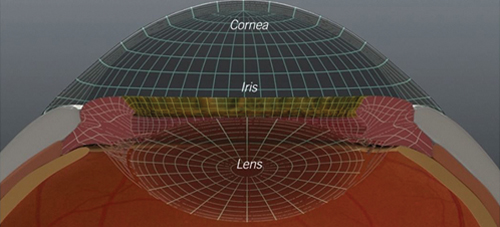
Step 1. Optical Coherent Tomography (10,000 HD Scans) makes a 3-D Map of the Lens, the Iris and the front of the eye.
Precisely positioned incision orientation and depth, including the safety zones, based on the treatment plan once all eye structures have been mapped. Benefit: Not based on human guess-work and manual estimation of size and shape of the eye. Safety zone = less human error.
Step 2. 100% Bladeless Laser makes Incisions, Openings and Cuts in the eye, cataract with gas bubbles.
Laser delivers cold femtosecond gas bubbles to replace surgeons’ hand-held blades. Benefit: No blades involved, quicker cataract removal with less ultrasound energy = quicker recovery.
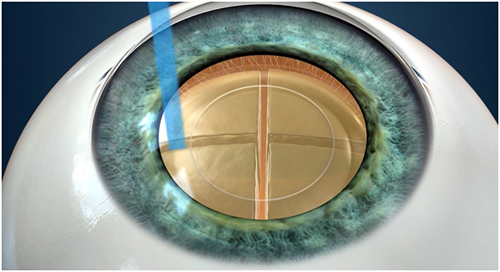
Step 3. Implant intraocular Lens ( IOL), with computer-guided precision
Near-to-perfect overlap with a well centered Multi-focal IOL (MF) and full correction of astigmatism is crucial to achieving an enhanced range from the near-to-distance spectrum of vision.
“Remember a Multi-focal Toric IOL is more sensitive to poor centration or astigmatism cylinder misalignment than mono-focal Toric IOL”. Dr David Goh, Medical Director.
My preferred choice for implantation of Premium MF IOLs is to combine the gentle but precise Bladeless Femtosecond Laser system to achieve the best centration and overlap for the MF Toric lens combined with the digital technology of the astigmatism axis-alignment system to perfectly align the premium lens implant in the required position, to ensure the best visual outcomes for the cataract patients.
Our aim is for continuous improvements and to deliver next-generation outcomes with precision cataract surgery and lens implantation technology, in our dedicated Eye Ambulatory Surgery Centre.
Make an appointment with Dr David Goh now!

Treatment of Meibomian Gland Dysfunction can improve
Cataract Surgery outcomes
Frequently Asked Questions – Cataract
I have recently seen an ophthalmologist for blurred vision that cannot be corrected with glasses. I have since been diagnosed with cataracts in both eyes. What should I do now? Can it be cured? How can I plan to pay for the surgery?
Yes, cataract is the clouding of the natural lens which is often caused by ageing and can be treated with surgery. However, to undergo cataract surgery, you should first identify a skilled Ophthalmologist recommended by friends and relatives. Alternatively, you may also do some research online to see reviews others have written regarding their experience before, during and after cataract surgery, and their overall satisfaction with the Ophthalmologists. Afterall, having good vision is essential for our daily life!
Now, you must be wondering:
Yes, cataract surgery is insurance claimable under “hospital plan” policies. Insurance is categorised into 2 types:
a. Integrated Shield Plan (ISP) – The insurance you have purchased for yourself as a top-up to the basic Medishield Plan
b. Corporate Insurance – The insurance provided by your employer or company
For Local Patients:
Any balance not covered by your Integrated Shield Plan may be paid using Medisave (up to $3,210 per eye from your own or an immediate family member’s account).
If you have corporate insurance, you may use it in addition to cover part or all of your cataract surgery expenses.
If you have both an Integrated Shield Plan and corporate insurance, you can decide between the sequence of claims, allowing you to leverage coverage from both. For example, if you have chosen to claim your surgery bill through your corporate insurance first, you can inform us of the reimbursed amount, and we can assist in claiming the remaining balance from your Integrated Shield Plan. Any remaining balance can still be settled using Medisave.
Whilst some hospitals charge more for foreigners, our eye centre does not — the cost of cataract surgery is the same for both locals and foreigners. If you have insurance from your home country, you may also wish to check with your provider whether cataract surgery is covered, should you decide to proceed with cataract surgery in Singapore.
Yes, the type of IOL implant chosen will affect your out-of-pocket expenses. We offer a variety of lenses, including Trifocal, Extended Depth of Focus (EDOF), and Monofocal IOL. Many patients select Trifocal or EDOF lenses to reduce dependence on glasses after surgery. However, these premium IOLs will incur your own cash top-up for some companies who only cover for basic monofocal IOL that does not treat presbyopia (and astigmatism.)
No, it is not necessary to pick a doctor from your insurance company to perform your cataract surgery.
If you did not buy a rider for your insurance policy plan, the deductible incurred will be the same, whether you have chosen a panel or non-panel doctor to perform your cataract surgery.
If you have a rider, the difference between a panel and non-panel doctor mainly lies in the coverage period for post-operative claims. The coverage period for panel doctors usually ranges from 180 to 365 days, depending on the insurance company. The coverage period for non-panel doctors usually ranges from 100-365 days, depending on the insurance company as well. However, please be reassured that cataracts is not a chronic disease; cataracts are totally treatable with cataract extraction surgery. Post-op care is normally completed within 4-6 weeks of follow-up period, making a claim period of only up to 100 days more than adequate for discharge.
No, we do not require any upfront deposits from you. Our eye centre has a day surgery facility where we perform operations in, allowing you the flexibility to fix the date of your surgery based on your own time and convenience. Some eye centres require upfront deposits and cancellation fees as they would have to reserve a slot in other day surgery centres to perform the surgery, and cannot afford any cases where you do not turn up on the day of your surgery.
Should you need to cancel your surgery at the last minute, even up to the day of your surgery, there is no cancellation fee.
Our dedicated Ophthalmology Day Surgery Centre is located directly opposite our eye centre. This saves our patients from having to travel to an unfamiliar place on the day of their actual cataract surgery.